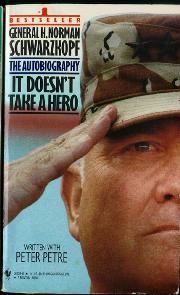
Norman Schwarzkopf
It Doesn't Take a Hero
Commander of the United Nations allied forces during the liberation of Kuwait in 1991-1992,
General H. Norman Schwarzkopf narrates an excellent autobiography of his life and career.
Telling his story in a straight-forward and candid style,
Schwarzkopf delivers a riveting account of the
first Gulf War, offering his personal perspectives in a behind the scenes look into
the events and diplomacy leading up to the battle for Kuwait.
The title of his autobiography comes from an interview with the US television personality Barbara Walters in 1991: "It doesn't take a hero to order men into battle. It takes a hero to be one of those men who goes into battle."
Having grown up in military family, and spending many years of his childhood in the Middle East, General Schwarzkopf
acquired the skills and languages, as well as an appreciation for
other cultures, that stood him well while serving as a military
officer. His insights into the politics of the Middle East and his
connections with leaders in the region during the first Gulf war enabled him to resolve many
diplomatic issues before they escalated, thereby forging
and sustaining a coalition of many disparate nations to ensure a
successful result to the conflict.
Schwarzkopf's outlook on military operations and strategy developed over the course of a lifetime. His autobiography covers much of his formative years and his personal experiences in the army during the
Vietnam War. Like General Collin Powell, Schwarzkopf rails against the stupidity and arrogance of that war, which led to the senseless sacrifice of so many people by politicians and military 'brass.' Both Schwarzkopf and Powell became equally convinced
of the need to work towards changing the army from within.
This autobiography also describes how the army had changed during the intervening years between
Vietnam and the first Gulf war. Schwarzkopf's candid review of the performance of his own army and the officers under his command, while based in the Saudi Arabian desert, generated intense criticism from the military establishment. Yet this candid review offers the reader a rare behind the scenes look at the entire Gulf war operation. Throughout the book, Schwarzkopf refrains from naming individuals who might otherwise deserve criticism, while including and highlighting those who deserve praise. This quality reflects the great character of a man whose outlook on military operations and strategy succeeded after being put to the ultimate test.
An excerpt from the book describes his youthful experience at the International School:
"I considered myself a typical international scholar, complete with long hair and sandals, after
completing a year of school in Geneva, Switzerland"
"Ecolint, as everybody called it, was egalitarian, not very fancy, and reasonably inexpensive. ... The
war had a dramatic effect on everyone at Ecolint. My schoolmates included children of British
aristocrats who had been sheltered there from the time of the blitz, as well as tough teenagers from
Eastern Europe who had been raised in communist partisan groups and were there to catch up on
their formal education."
"I heard my first opera and smoked my first cigarette on the same night. ... I was equally urbane the first
time I kissed a girl. Claudine was a sexy French sophomore .. who decided she had a crush on me. She
invited me for a walk on the wooded path that wound around behind the athletic fields. This was where couples
went; there was a tree along the way where everyone was expected to kiss. I'm sure that Claudine .. expected a
passionate French kiss. But what she got was a mere peck from my puckered lips."
From amazon.com (USA):
It Doesn't Take a Hero
Kindle eBook Editions:
It Doesn't Take a Hero
American Warrior: A Combat Memoir of Vietnam, by John C. (Doc) Bahnsen Jr., Wess Roberts, Foreword by Gen. H. Norman Schwarzkopf
Edited by H. Norman Schwarzkopf:
Spirit of the Wilderness, by Boone and Crockett Club, Theodore Roosevelt IV, General H. Norman Schwarzkopf, William MacCarty M.D., Denver Bryan, John M. Kauffmann, Prentiss N. Gray, Theodore J. Holsten Jr., Richard Borden, Richard P. Carlsberg, Susan C. Reneau, Jack Reneau
Works with contributions by H. Norman Schwarzkopf:
The Military Advantage: A Comprehensive Guide to Your Military & Veterans Benefits, by Christopher P. Michel and Norman Schwarzkopf
American Warrior: A Combat Memoir of Vietnam, by John C. (Doc) Bahnsen Jr., Wess Roberts, Foreword by Gen. H. Norman Schwarzkopf
Beyond Glory: Medal of Honor Heroes in Their Own Words, by Larry Smith, Eddie Adams, Introduction by Gen. H. Norman Schwarzkopf
West Point: Two Centuries of Honor and Tradition, by Stephen Ambrose, William F. Buckley, David Halberstam, Arthur Miller, George Plimpton, Tom Wicker, H. Norman Schwarzkopf
A Tale of Three Wars: A Novel, by Edward B. Atkeson, Introduction by Gen. H. Norman Schwarzkopf
Biography of H. Norman Schwarzkopf:
In the Eye of the Storm, by Roger Cohen and Claudio Gatti
Norman Schwartzkopf: Hero With a Heart, by Libby Hughes